



 NEWS
NEWS
 Inter World Steel
The structural drawings are ready, the crew is waiting, and the same question comes up again: how many bars of D16 and Ø8 should be ordered? Order too few and work stops while you wait for a second delivery. Order too many and your cash sits on site as a pile of rusting steel.
Many people reach for a "magic number" of kilograms of steel per cubic metre of concrete found online. Such figures are fine for a rough estimate, but not for a purchase list. This article shows how to calculate directly from the drawings, with two worked examples for a column and a beam, and then turns the result into a bar count that is ready to order.
Why a single kg per m³ ratio does not work
The ratio of steel to concrete volume is set by the structural engineer, not by habit. Three things affect it most:
- Element type. Columns carry compression and bending from two directions, so they are usually reinforced more densely than beams of similar size.
- Cross-section size. A small section with the same number of bars gives a much higher kg/m³ ratio.
- Stirrup spacing and lap length. Tighter stirrups near supports and lap splices add weight without adding concrete volume.
The examples below prove the point: with the same bar diameters, the column comes out at about 194 kg/m³ and the beam at about 130 kg/m³. The gap is far too wide to be replaced by one average figure.
Data you need before calculating
From the structural drawings
- Cross-section dimensions (width × depth) and element length or height
- Number and diameter of main bars, for example 8 D16
- Stirrup diameter and spacing, for example Ø8-150
- Concrete cover and the required lap or anchorage length
Bar weight per metre according to SNI
Weight is calculated with the formula 0.006165 × d² kg/m and depends only on diameter, for both plain and deformed bars. The full D8 to D40 table is in our SNI rebar size and weight table.
| Diameter | Weight per metre | Weight per bar (12 m) | Typical use |
|---|---|---|---|
| 8 mm | 0.395 kg | 4.73 kg | Stirrups |
| 10 mm | 0.617 kg | 7.40 kg | Stirrups, slab reinforcement |
| 13 mm | 1.042 kg | 12.50 kg | Main bars for light elements |
| 16 mm | 1.578 kg | 18.94 kg | Main bars for columns and beams |
Example 1: 30 × 30 cm column
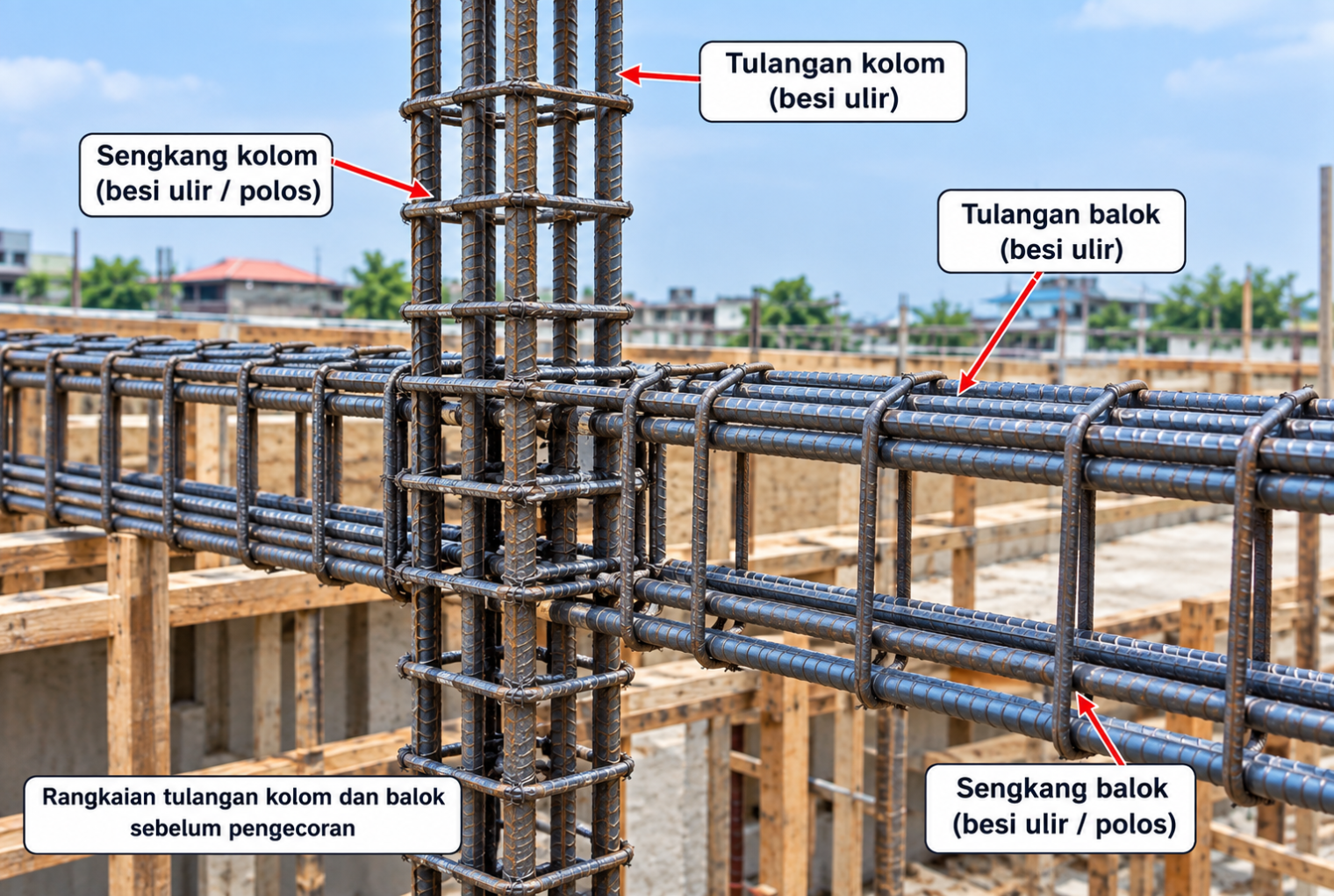
Assumptions (replace with the figures on your drawings): height 4 m, main bars 8 D16, stirrups Ø8-150, concrete cover 40 mm, lap splice 40d = 0.64 m once per bar, stirrup hook 10d at each end.
- Length of one main bar = 4 + 0.64 = 4.64 m
- Total main bars = 8 × 4.64 = 37.12 m × 1.578 kg/m = 58.58 kg
- Length of one stirrup = 2 × (300 − 80) + 2 × (300 − 80) + 2 × 80 = 1,040 mm = 1.04 m
- Number of stirrups = (4,000 ÷ 150, rounded down) + 1 = 27 pieces
- Total stirrups = 27 × 1.04 = 28.08 m × 0.395 kg/m = 11.09 kg
Steel for one column is 69.67 kg. The concrete volume is 0.3 × 0.3 × 4 = 0.36 m³, giving a ratio of about 194 kg/m³.
Example 2: 25 × 40 cm beam
Assumptions: span 5 m, main bars 5 D16 (3 bottom, 2 top), stirrups Ø8-150, cover 40 mm, 40d anchorage at both ends.
- Length of one main bar = 5 + 2 × 0.64 = 6.28 m
- Total main bars = 5 × 6.28 = 31.40 m × 1.578 kg/m = 49.55 kg
- Length of one stirrup = 2 × (250 − 80) + 2 × (400 − 80) + 2 × 80 = 1,140 mm = 1.14 m
- Number of stirrups = (5,000 ÷ 150, rounded down) + 1 = 34 pieces
- Total stirrups = 34 × 1.14 = 38.76 m × 0.395 kg/m = 15.31 kg
Steel for one beam is 64.86 kg. The concrete volume is 0.25 × 0.4 × 5 = 0.50 m³, giving a ratio of about 130 kg/m³.
| Element | Main bars | Stirrups | Total | Concrete volume | Ratio |
|---|---|---|---|---|---|
| Column 30 × 30, 4 m high | 58.58 kg | 11.09 kg | 69.67 kg | 0.36 m³ | ± 194 kg/m³ |
| Beam 25 × 40, 5 m span | 49.55 kg | 15.31 kg | 64.86 kg | 0.50 m³ | ± 130 kg/m³ |
From kilograms to the number of bars to order
Rebar is delivered in 12-metre bars, so the kilogram figure must be converted into a bar count that accounts for cutting. Suppose a project has 20 columns and 24 beams like the examples above:
- D16 for columns: 160 pieces @ 4.64 m. One 12 m bar yields 2 pieces (2.72 m offcut), so 80 bars are needed.
- D16 for beams: 120 pieces @ 6.28 m. One bar yields only 1 piece (5.72 m offcut), so 120 bars are needed.
- Ø8 column stirrups: 540 pieces @ 1.04 m, 11 per bar, 50 bars needed.
- Ø8 beam stirrups: 816 pieces @ 1.14 m, 10 per bar, 82 bars needed.
| Diameter | Number of bars | Weight per bar | Total weight |
|---|---|---|---|
| D16 (deformed) | 200 | 18.94 kg | 3,788.00 kg |
| Ø8 (plain) | 132 | 4.73 kg | 624.36 kg |
| Total | 4,412.36 kg (± 4.41 tonnes) |
Note that the net steel actually installed is only 2,949.96 kg. The difference is offcuts. The 5.72 m left from each beam bar can still be used for starter bars, slab reinforcement, or other elements, and a well-prepared bar bending schedule can cut the order quantity noticeably.
Common mistakes when estimating rebar
- Forgetting lap splices and anchorage. In the column example, the lap adds 16% to the main bar length.
- Dividing the length by the spacing without adding one stirrup. A small difference per element becomes dozens of bars across a project.
- Using one kg/m³ ratio for every element. The column and beam ratios above are far apart, let alone slabs and foundations.
- Calculating with nominal weight, then accepting undersized bars. If the delivered steel is lighter than the SNI standard, your numbers are right but the structure is not. Weigh sample bars and check them against the mill certificate.
- Swapping deformed bars for plain bars. They weigh the same but bond differently. See the difference between plain and deformed rebar.
Frequently Asked Questions
How many kg of steel per m³ of concrete does a column need?
There is no single figure. For the example 30 × 30 cm column with 8 D16 and Ø8-150 stirrups, the result is about 194 kg/m³. A column with a different section or bar count will give a different number, so the calculation must still come from the structural drawings.
What percentage should be added as a margin?
The margin depends on how carefully the cutting list is prepared. The most accurate method is to count bars from the cutting pattern as shown above, rather than adding a fixed percentage to the net weight.
Do plain and deformed bars of the same diameter weigh differently?
No. Under the SNI formula, weight depends only on diameter. D16 deformed and Ø16 plain bars both weigh 1.578 kg per metre.
Can this calculation replace a structural engineer?
No. This article helps translate structural drawings into an order list. Dimensions, bar counts, and stirrup spacing must still be specified by a qualified engineer.
How much would the steel in this example cost?
Steel prices move with raw materials and exchange rates, so we do not publish figures in articles. Send your bar list per diameter to our sales team for a quotation and a current stock check.
Send your bar list, get a quotation
PT Inter World Steel Mills Indonesia in Tangerang produces plain (BjTP) and deformed (BjTS) rebar certified to SNI 2052:2024, supplied with SPPT-SNI and a mill certificate for every batch, backed by more than 50 years of serving contractors, distributors, and infrastructure projects.
Already have a bar list per diameter like the table above? Send it through the Order Now page or contact our sales team for pricing and stock availability. Grades and diameters are listed on the product specification page.