



 NEWS
NEWS
 Inter World Steel
On Indonesian job sites the names vary: "besi banci", undersized bars, non-SNI steel, or "full-size" bars that turn out not to be full. They all mean the same thing: bars sold under a certain diameter label while their real size and weight fall below the standard. A D13 bar that is actually equivalent to 12 mm looks no different from a distance, especially once it is stacked with hundreds of other bars.
The problem is not just feeling cheated. The cross-sectional area of the steel sets the tensile capacity that the structural engineer used in the design. Underweight bars mean your columns, beams, and slabs carry loads with less reinforcement than the drawings specify. This article explains the warning signs, how to check with simple tools, and a worked calculation to prove it.
What undersized rebar actually is
"Besi banci" is the market term for bars whose real size is smaller than the nominal size stated by the seller. In practice the term is also used for steel with no traceable mill or certificate. The two issues are different:
- Undersized: the diameter and weight per metre are below the SNI figures for the labelled diameter.
- Untraceable: there is no manufacturer identity, SPPT-SNI, or mill certificate, so the strength grade cannot be proven even if the size looks right.
Steel that is safe for structures must pass both tests: its weight meets the standard, and its origin can be traced back to a production batch. The standard itself is explained in our SNI rebar guide.
Signs you can spot on site
Visual signs
- No embossed marking or manufacturer identification on the bar, or markings that do not match the documents supplied.
- Different diameters in one bundle with the same label. Line up several bars and compare their cut ends.
- Uneven or very thin ribs on deformed bars, which puts their bond with concrete in doubt.
- Bars that bend easily by hand at a size that should be stiff, or that crack when bent on a bending tool.
- A price per bar far below the market. A striking price gap is almost always paid for with reduced weight.
Signs in the paperwork
- The seller cannot show an SPPT-SNI or mill certificate.
- The batch or heat number on the mill certificate cannot be matched to the bundle tags.
- The invoice only says "13 bar" with no grade, standard, or manufacturer name.
How to check: weigh, do not just measure
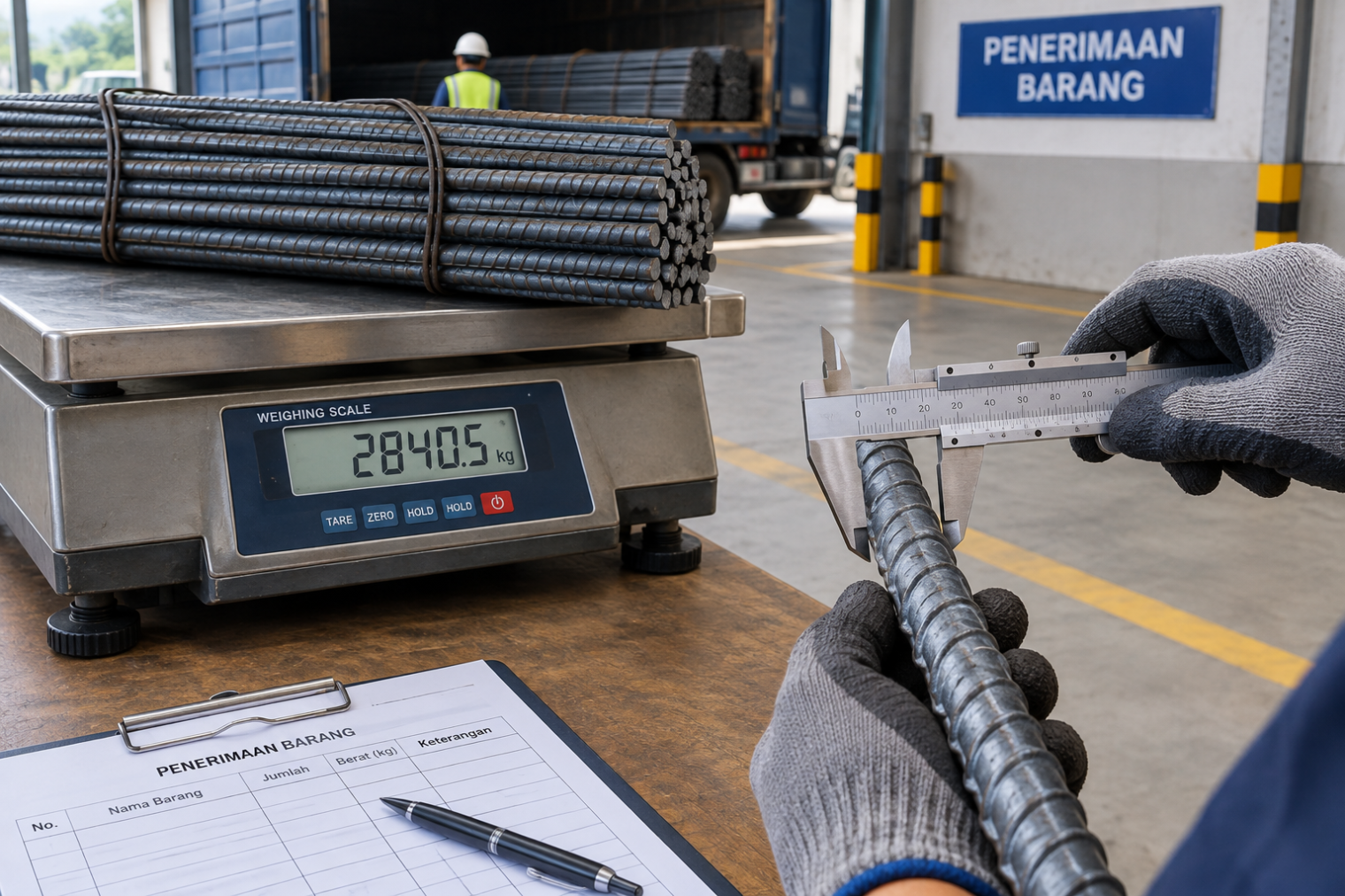
A vernier caliper is useful, but on deformed bars the result is often confusing because the ribs get measured too. The most reliable method is weighing, because SNI sets the weight per metre for each diameter using the formula 0.006165 × d². From the weight, the effective diameter can be calculated back:
Effective diameter (mm) = √(weight per metre ÷ 0.006165)
Checking steps
- Pick several bars at random from different bundles, not only from the top of the stack.
- Confirm the length is truly 12 m with a tape. If you cut a sample, measure its length carefully.
- Weigh it on a calibrated scale.
- Divide the weight by the length to get the weight per metre.
- Compare with the SNI table and calculate the effective diameter.
- Check the result against the tolerance limits in the standard and on the mill certificate for that batch.
Worked example from weighing results
The table below is an illustration, not data from any particular supplier. All bars are assumed to be 12 m long.
| Label | SNI weight per bar | Weighed | Weight per metre | Effective diameter | Weight shortfall |
|---|---|---|---|---|---|
| D13 | 12.50 kg | 10.20 kg | 0.850 kg | 11.74 mm | 18.4% |
| D16 | 18.94 kg | 15.60 kg | 1.300 kg | 14.52 mm | 17.6% |
| D10 | 7.40 kg | 7.25 kg | 0.604 kg | 9.90 mm | 2.0% |
Breaking down the first row: 10.20 kg ÷ 12 m = 0.850 kg/m. The effective diameter is √(0.850 ÷ 0.006165) = 11.74 mm. In other words, the bar sold as D13 is really closer to 12 mm. Its weight is 18.4% below the SNI figure (12.50 kg).
Because cross-sectional area is proportional to weight, that bar provides only about 81.6% of the steel area the engineer designed for. In the second example, the D16 bar retains only about 82.4%. The third row shows a 2.0% shortfall, a small gap that should be compared with the tolerance limits of the standard before deciding to accept or reject the delivery.
Why buyers often do not notice
- Sold per bar, not per kg. Buyers compare prices per bar without knowing each bar's weight. A fair comparison is the price divided by the actual weight.
- Only checked visually. A 1 to 2 mm difference in diameter is almost impossible to see without weighing.
- Documents treated as a formality. The mill certificate is the only solid proof of tensile and yield strength, which cannot be tested on site.
- Goods receiving is left entirely to the delivery party. Without someone on your side weighing samples and matching bundle tags to documents, an undersized delivery can go straight into the site store and be installed before anyone notices. Set a written receiving procedure from the first order, including who weighs, how many samples are taken, and when unloading is allowed.
Frequently Asked Questions
Is undersized rebar always lighter than SNI?
Usually yes, because the easiest way to cut the price is to cut the material. However, bars with the correct weight are not automatically safe if their strength grade is not proven by a mill certificate and SPPT-SNI.
Can the diameter of deformed bar be measured with a caliper?
Yes, as a first check, but the ribs make the result inconsistent. Weighing and calculating the effective diameter from the weight per metre is far more reliable.
How many bars should be weighed when a delivery arrives?
Take random samples from several bundles for every diameter delivered. The larger the order, the more samples are worth taking. If even one sample is well below standard, check the other bundles before accepting the goods.
What should I do if the delivered steel is undersized?
Record the weights, photograph the bundle tags, and do not install the bars. Report it to the supplier with your calculations, and consult the structural engineer if some bars have already been installed.
How can I be sure the steel I buy is not undersized?
Buy from a manufacturer or authorised distributor that can provide an SPPT-SNI and a mill certificate per batch, and still weigh samples on arrival. A goods-receiving checklist is available in our premium SNI rebar article.
Buy directly from a certified mill
PT Inter World Steel Mills Indonesia in Tangerang produces plain (BjTP) and deformed (BjTS) rebar certified to SNI 2052:2024, with more than 50 years of experience. Every delivery can come with an SPPT-SNI and a mill certificate per batch, so you can match your weighing results against official data. See the documents on our certification page.
Need confirmed stock and a quotation for your project? Contact our sales team or send your requirements through the Order Now page.