



 NEWS
NEWS
 Inter World Steel
Almost every rebar quotation in Indonesia says "SNI". The catch is that the SNI for reinforcing steel is not a permanent document. It is revised periodically, and since 2024 the applicable reference is SNI 2052:2024, which replaces SNI 2052:2017. Many drawings, tender specifications and technical documents prepared a few years ago still cite the old edition, including a grade that is no longer listed.
That can cause real friction on site: the supervisor asks for a mill certificate referencing the current standard while the supplier sends documents citing the old one, or the drawings call for a grade that the new standard no longer covers. This article summarises what SNI 2052:2024 is, what changed, what stayed the same, and the practical steps that keep your rebar procurement from getting stuck on paperwork.
What is SNI 2052:2024?
SNI 2052:2024 is the Indonesian National Standard issued by the National Standardization Agency (BSN) for reinforcing steel for concrete: plain bars (BjTP) and deformed or ribbed bars (BjTS) used as reinforcement in concrete structures. It sets requirements for material and chemical composition, nominal sizes and tolerances, mass per metre, bar length, mechanical properties proven through tensile and bend tests, and the manufacturer identification marks rolled onto each bar.
In short, SNI 2052:2024 is the checklist a rebar must pass to be called SNI rebar. The basics of types and grades are covered in our SNI rebar guide.
Legal basis: why the standard is mandatory
Most SNI standards are voluntary. For reinforcing steel, the government made it mandatory through Minister of Industry Regulation No. 55 of 2024 on the Mandatory Application of Indonesian National Standards for Reinforcing Steel. The regulation was signed on 15 October 2024 and promulgated on 18 October 2024.
The same regulation also makes two companion standards mandatory:
- SNI 2052:2024 — reinforcing steel (hot-rolled straight bars)
- SNI 65:2024 — re-rolled reinforcing steel
- SNI 954:2024 — reinforcing steel in coils
Because it is mandatory, rebar sold in Indonesia must carry a Product Certificate for the Use of the SNI Mark (SPPT-SNI). For buyers, the standard cited on a supplier's documents is therefore not a formality.
Six changes from SNI 2052:2017
Based on the summary of changes stated in the standard, these are the revision points:
| No | Change | What it means for buyers |
|---|---|---|
| 1 | Grade BjTS 420A removed | Drawings that still specify BjTS 420A should go back to the structural engineer for a replacement grade |
| 2 | Alloying elements may be added where needed | The chemical composition on a mill certificate may list alloying elements; values must still be within the standard's limits |
| 3 | Revised terms and definitions | Terminology in older specifications should be aligned to avoid disputes during inspection |
| 4 | New plain bar size P38 | One more diameter option for plain bars |
| 5 | Adjusted mechanical properties for BjTS 550 and BjTS 690 | Yield strength, tensile strength or elongation limits for these two grades follow new values; check mill certificates against the current tables |
| 6 | Revised bar lengths and length tolerances | At goods receipt, bar length is checked against the 2024 tolerances, not the 2017 ones |
We deliberately do not reproduce the mechanical limits and tolerances here. The official figures are in the standard published by BSN, and your structural engineer should refer to it directly. If you need figures for the grades we produce, our team can send the technical data.
What did not change: the mass formula and table
Many people assume a revision changes the weight of rebar. It does not. Nominal mass is still calculated from diameter as mass (kg/m) = 0.006165 × d², where d is the nominal diameter in millimetres. Plain and deformed bars of the same diameter weigh exactly the same.
| Diameter | Mass per metre | Mass per 12 m bar |
|---|---|---|
| 10 mm | 0.617 kg | 7.40 kg |
| 13 mm | 1.042 kg | 12.50 kg |
| 16 mm | 1.578 kg | 18.94 kg |
| 19 mm | 2.226 kg | 26.71 kg |
| 22 mm | 2.984 kg | 35.81 kg |
| 25 mm | 3.853 kg | 46.24 kg |
The full D8 to D40 table is in our article on the SNI rebar size and weight table. This table is the simplest tool for spotting undersized bars: weigh one bar and compare it with the figures above.
What it means for contractors and project owners
1. Update the reference in procurement documents
State "SNI 2052:2024" explicitly in purchase orders and specifications. A reference that only says "SNI" without the year leaves room for interpretation when disputes arise.
2. Check the grades on the drawings
If the drawings specify BjTS 420A, ask the structural engineer to confirm a replacement grade before ordering, not after the bars arrive on site.
3. Ask for documents citing the same standard
The mill certificate and SPPT-SNI should cite the applicable standard. We explain how to read them in how to read a rebar mill certificate.
How to verify rebar meets SNI 2052:2024
- Check the rolled-on marks on the bar: manufacturer identification, diameter and grade.
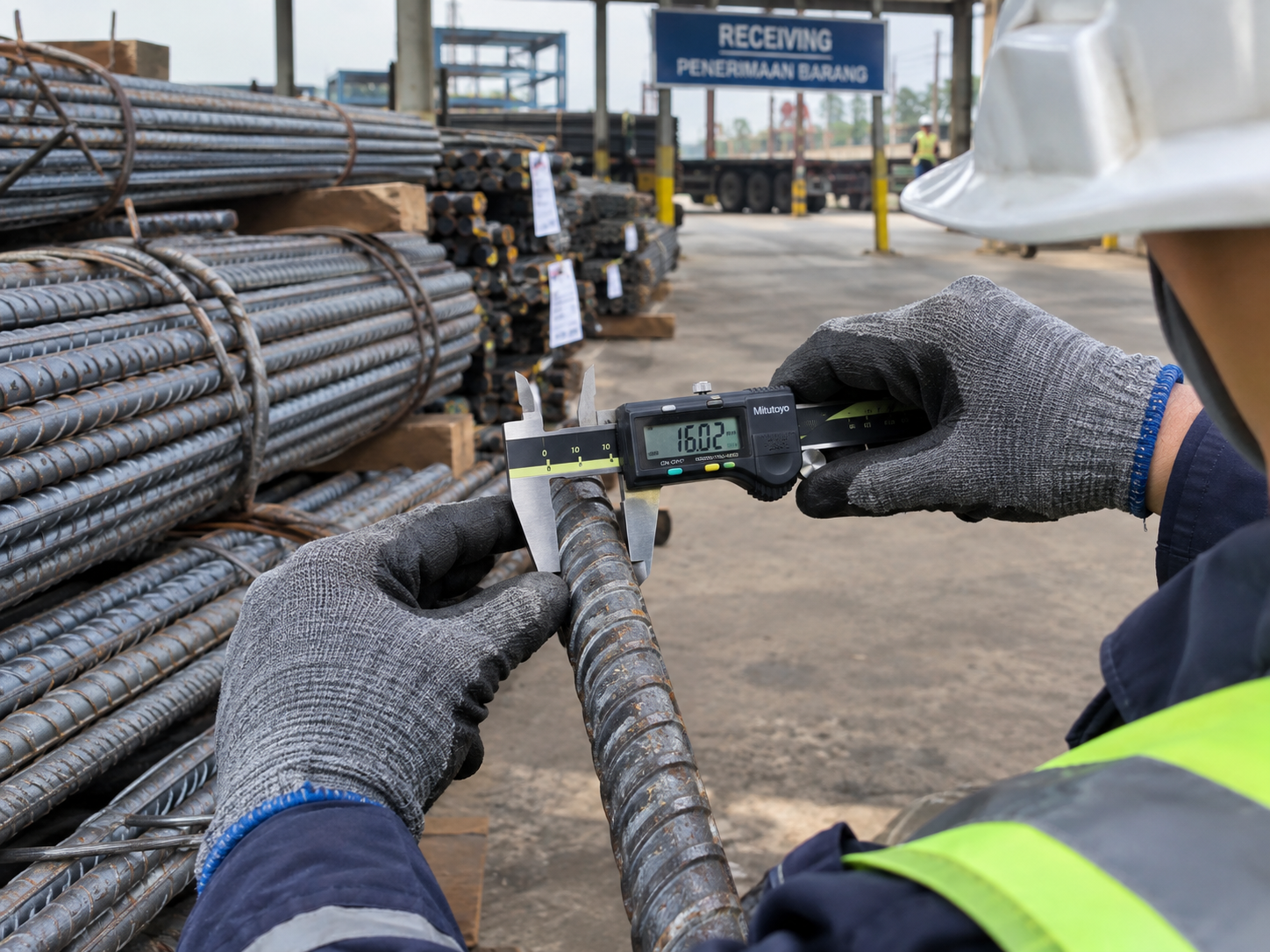
- Measure the diameter with a vernier caliper and compare it with the nominal size.
- Weigh a sample and compare it with the mass table above.
- Match the heat/batch number on the bundle tag with the mill certificate.
- Request a copy of a valid SPPT-SNI from the manufacturer.
The signs of bars that fail any of these steps are covered in how to spot undersized rebar.
Frequently Asked Questions
Is SNI 2052:2017 still valid?
The standard made mandatory by Minister of Industry Regulation No. 55 of 2024 is SNI 2052:2024. For new procurement, use the 2024 edition as the reference in all documents.
What replaces grade BjTS 420A?
SNI 2052:2024 no longer lists BjTS 420A. The replacement grade is decided by your project's structural engineer based on design requirements, not by the supplier.
Did rebar weights change in SNI 2052:2024?
No. Nominal mass still follows 0.006165 × d² kg per metre, so a D16 bar is still 1.578 kg per metre or 18.94 kg per 12 m bar.
Does SNI 2052:2024 cover plain bars too?
Yes. The standard covers plain bars (BjTP) and deformed bars (BjTS). The 2024 revision even adds a new plain bar size, P38.
How do I know the rebar I buy meets SNI 2052:2024?
Ask for an SPPT-SNI and mill certificate citing SNI 2052:2024, then match the batch number, rolled-on marks, diameter and bar weight against those documents at goods receipt.
SNI 2052:2024 Rebar Direct from the Mill
PT Inter World Steel Mills Indonesia produces SNI 2052:2024-certified plain and deformed rebar at our mill in Tangerang, with an SPPT-SNI and mill certificate for every delivery. See available sizes and grades on our product specification page, or request a quotation and check stock — our sales team can help match the grade to your project drawings.