



 NEWS

 Inter World Steel
Contractors who order reinforcing bar in 12-metre lengths are often surprised when they weigh the offcuts at the end of a project. The tonnage on the delivery note is correct, the net weight installed matches the drawings, yet the gap between the two can reach fifteen to twenty-plus percent. That gap is almost always created at the fabrication stage: how the bars are cut, bent, and tagged before assembly.
This article explains rebar fabrication from the material buyer’s point of view: the steps involved, the bending rules that must be followed, how to prepare a bar bending schedule (BBS), and how to calculate how many bars actually need to be purchased. The worked example uses SNI weights, so you can use it straight away to check a quotation.
What Rebar Fabrication Is
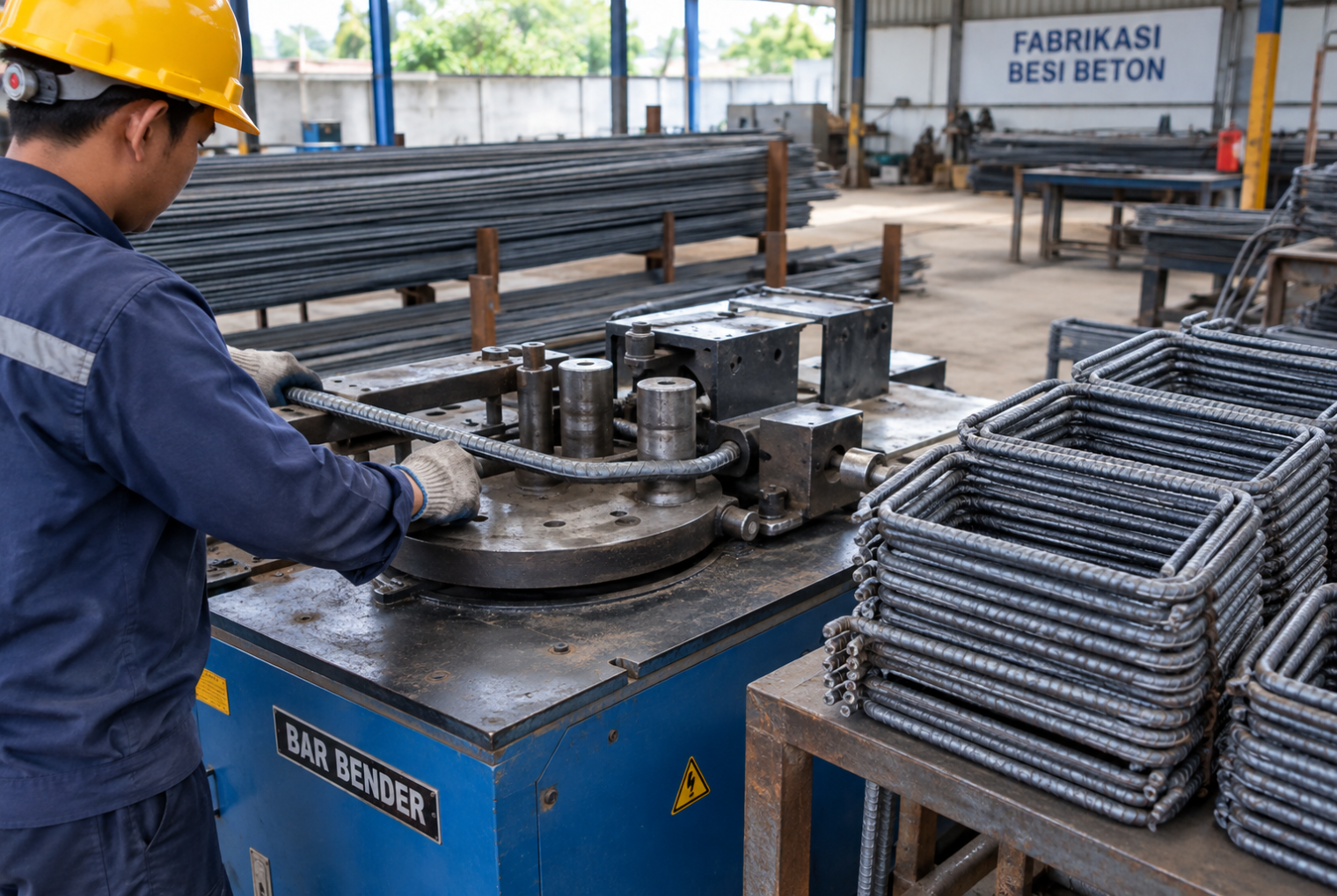
Rebar fabrication is the process of turning straight mill bars into ready-to-assemble pieces according to the structural shop drawings. It can be done on site with a bar cutter and bar bender, or at a fabrication yard that delivers finished pieces to the project.
The main steps
- Reading the shop drawings — determining the diameter, quantity, length, and shape of every bar.
- Preparing the bar bending schedule — a list of every bar mark with its cutting length and bend shape.
- Optimising the cutting pattern — combining pieces from 12 m bars so that offcuts are as small as possible.
- Cutting and bending — by machine, observing the minimum bend diameter.
- Tagging and bundling — every bundle carries its BBS mark so nothing is mixed up during assembly.
Fabrication is only as good as its raw material. Undersized or brittle bars will crack at the bend, so material checks belong before the bars go into the machine, not after.
Bending Rules That Must Be Followed
The minimum bend diameter (measured on the inside of the bend) is set out in SNI 2847:2019, Indonesia’s structural concrete code. A bend that is too tight over-stretches the steel on the outside face and can crack it, especially in high-grade deformed bar.
| Bar type | Bar diameter (db) | Minimum inside bend diameter |
|---|---|---|
| Main bars | D10 – D25 | 6 db |
| Main bars | D29 – D36 | 8 db |
| Stirrups and ties | D16 and smaller | 4 db |
For standard hooks, the commonly used references are: a 90° hook with a straight extension of 12 db, a 180° hook of at least 4 db or 65 mm, and a 135° stirrup hook of at least 6 db or 75 mm. The structural engineer may specify larger values; the figure on the shop drawing always governs.
Two site habits to avoid: heating bars with a torch to make them easier to bend, and straightening a bar that was bent wrongly. Both change the mechanical properties of the steel and are not permitted without the engineer’s approval.
Bar Bending Schedule Example
The example below covers 10 identical beams. Cutting lengths are assumptions for illustration; the 1.10 m stirrup length already includes both hooks. Weights use the SNI formula 0.006165 × d², i.e. 1.578 kg/m for D16 and 0.617 kg/m for D10.
| Mark | Description | Diameter | Shape | Cutting length | Qty | Total length | Weight |
|---|---|---|---|---|---|---|---|
| B1 | Beam bottom bars | D16 | Straight | 4.60 m | 30 | 138.00 m | 217.76 kg |
| B2 | Beam top bars | D16 | Straight | 4.60 m | 20 | 92.00 m | 145.18 kg |
| S1 | Stirrups | D10 | Closed stirrup, 135° hooks | 1.10 m | 270 | 297.00 m | 183.25 kg |
| Total net weight | 546.19 kg | ||||||
This net weight of 546.19 kg is the steel actually installed. It is the figure that usually appears in quantity take-offs, yet the amount purchased is always higher.
Calculating How Many Bars to Buy
Rebar is sold in 12 m bars, so every bar mark has to be mapped onto a cutting pattern:
- D16 at 4.60 m: one bar yields 2 pieces (9.20 m) with a 2.80 m offcut. Fifty pieces require 25 bars × 18.94 kg = 473.50 kg.
- D10 at 1.10 m: one bar yields 10 pieces (11.00 m) with a 1.00 m offcut. 270 pieces require 27 bars × 7.40 kg = 199.80 kg.
The total purchased is 673.30 kg, while 546.19 kg is installed. The difference of 127.11 kg, or 18.9%, ends up as offcuts. The split is uneven: D16 leaves 110.56 kg (23.3%), while D10 leaves only 16.55 kg (8.3%).
The lesson: offcut figures depend heavily on cutting length. A 4.60 m piece simply does not fit a 12 m bar well. The 2.80 m D16 offcuts can still be allocated to support bars, starter bars, or other marks if the drawings call for them; otherwise they become scrap. That is why the cutting pattern should be planned for the whole project at once, not element by element. To calculate requirements per structural element, see also how to calculate rebar for columns and beams.
Common Mistakes and How to Check Material Before Fabrication
- Not weighing samples. Weigh a few bars and compare them with the SNI rebar size and weight table. Undersized bars turn a BBS that is correct on paper into a weaker structure on site.
- Not asking for quality documents. Request a mill certificate for each batch and match the heat number with the bundle tag. A guide is available in how to read a rebar mill certificate.
- Mixing grades. BjTS 420 and BjTS 520 look alike at a glance. Keep bundles separated by grade from unloading onwards so they are not swapped at the cutter.
- Skipping the bend test. Bend one sample to the minimum diameter above. Cracking on the outside of the bend is a sign that the material should be held and confirmed with the supplier.
- Lost tags. Pieces without a BBS mark are almost certain to be misplaced or wasted.
Frequently Asked Questions
What is the difference between rebar fabrication and rebar fixing?
Fabrication is the stage of cutting and bending bars into ready-to-use pieces. Fixing is the stage of assembling and tying those pieces into reinforcement cages inside the formwork. Tidy fabrication makes fixing faster and reduces placement errors.
What offcut percentage is reasonable?
There is no fixed figure because it depends heavily on cutting lengths. In the example above the offcut is 18.9%, most of it from a single bar mark. The best way to reduce it is to plan the cutting pattern for the project’s entire BBS rather than relying on an average allowance.
Can deformed bar be bent on site?
Yes, provided a bar bender is used with the minimum bend diameter required by SNI 2847:2019 and without heating. What is not recommended is re-bending or straightening a bar that has already been bent.
Does Inter World Steel offer cutting and bending services?
Our standard products are straight plain and deformed bars certified to SNI 2052:2024. For special lengths or services, please ask our sales team directly so you get an answer that fits your project.
What should I prepare when ordering for fabrication?
A summary of requirements per diameter and grade in bars or tonnes, a delivery schedule, and the unloading location. With that information the sales team can check stock and prepare a quotation.
Start With Material Whose Size You Can Trust
A careful BBS means little if the bar diameter and weight do not meet the standard. PT Inter World Steel Mills Indonesia produces plain (BjTP) and deformed (BjTS) reinforcing bar in Tangerang, certified to SNI 2052:2024 and supplied with a mill certificate per batch. See our product specifications and certifications, then send your project requirements through the Order Now page to request a quotation and check stock.